The blank page has intimidated writers for centuries. From novelists to poets, journalists to academics, the challenge of transitioning from everyday life to creative flow remains constant. This is where writing rituals come in—those peculiar, personal practices that help writers shift their minds into the creative space required for their craft.
Ernest Hemingway famously wrote standing up, beginning at first light. “There is no one to disturb you and it is cool or cold and you come to your work and warm as you write.” Hemingway would count his daily word output on a chart. This ritual of early rising, standing at his desk, and meticulously tracking progress created the conditions for his distinctive prose.
Maya Angelou rented hotel rooms by the month solely for writing. She would arrive at 6:30 a.m., bringing only a Bible, a thesaurus, a dictionary, and a bottle of sherry. “I try to get there around seven, and I work until two in the afternoon,” she explained. “If the work is going badly, I stay until 12:30. If it’s going well, I’ll stay as long as it’s going well.” This physical separation from home created a sacred space for her creativity.
King’s ritual centres on unwavering consistency. “I have a glass of water or a cup of tea. There’s a certain time I sit down, from 8:00 to 8:30, somewhere within that half hour every morning,” he has said. King aims for 2,000 words daily and doesn’t stop until he reaches his goal. His approach shows how routine itself becomes a powerful creative trigger.
Murakami’s ritual blends physical discipline with creative work. He rises at 4 a.m., writes for five to six hours, then runs 10 kilometres or swims 1500 metres (or sometimes both). “Physical strength is as necessary as artistic sensitivity,” he’s noted. His ritual shows how bodily discipline can support mental clarity.
Before beginning work, Joan Didion would sleep in the same room as her manuscript. She would also take an hour before dinner to have a drink and read what she’d written that day, not to edit but to “cool out… I can’t read it if I’m still all tensed up from the day.”
Morrison rose before dawn to write. “I always get up and make a cup of coffee while it is still dark—it must be dark—and then I drink the coffee and watch the light come,” she said. “Writers all devise ways to approach that place where they expect to make the contact, where they become the conduit, or where they engage in this mysterious process.”
The Science Behind Writing Rituals
Psychologically, rituals function as triggers that signal to our brains it’s time to shift into a specific mental state. Professor Robert Boice, who studied writer’s block extensively, found that writers who develop consistent rituals are more productive and experience less creative blockage.
According to Mihaly Csikszentmihalyi’s research on flow states, rituals help create the conditions for flow—that optimal state of consciousness where we feel our best and perform our best. Rituals eliminate decision fatigue and reduce the activation energy needed to begin writing.
Neuroscience research suggests that ritualistic behaviour reduces cognitive load. When parts of our routine become automatic, our prefrontal cortex—responsible for executive function—can dedicate more resources to creative thinking rather than deciding what to do next.
Writing rituals create what psychologists call ‘psychological safety’—an environment where the mind feels secure enough to take creative risks. This safety comes from the predictability of the ritual itself.
Many writers’ rituals align with their natural circadian rhythms. Research shows that creative thinking may peak during different times for different people. Morning people like Hemingway and Morrison leveraged their natural alertness early in the day, while night owls might find their creative peak comes later.
Creating Your Own Writing Ritual
Notice when your mind feels most alert and creative. Are you sharper in the morning like Hemingway, or do you find clarity in the evening?
Maya Angelou’s hotel room shows the importance of a dedicated writing space. Even if it’s just a corner of your home, having a physical location associated only with writing helps train your brain.
Many writers include sensory triggers in their rituals—specific music, a certain tea or coffee, particular lighting, or even scents. These sensory cues become powerful anchors for creative states.
Stephen King’s cup of tea and Murakami’s exercise regimen show the value of pre-writing activities. Consider what helps you transition from everyday thinking to creative focus.
The most effective rituals are those practiced consistently. While spontaneous creativity is wonderful, a regular schedule trains your creative mind to show up reliably.
Joan Didion’s evening review demonstrates the value of proper closure. Having a way to conclude your writing session helps your mind process what was accomplished and prepare for the next day.
My Writing Ritual
I’ve found that developing my own ritual has been transformative for my writing practice. My routine changes subtly with the seasons, responding to both practical needs and sensory preferences that shift throughout the year.
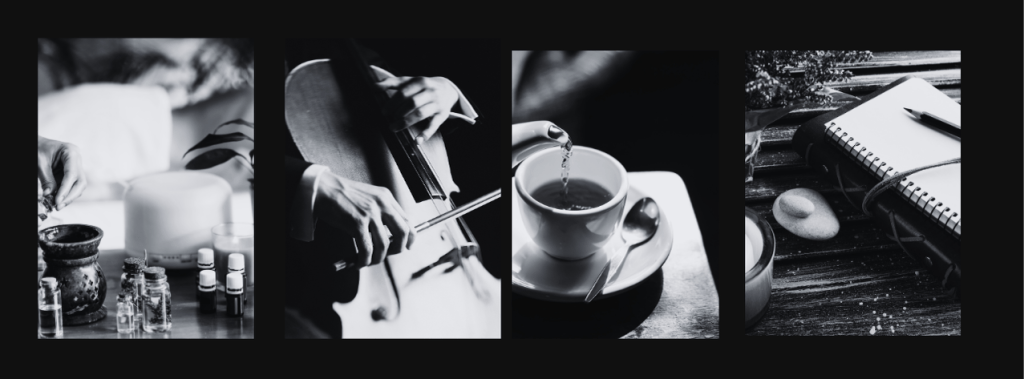
In winter, my ritual begins with opening the blinds to welcome whatever precious daylight the season offers. I light a candle, its small dancing flame offering both literal and metaphorical warmth during the cold months. Rich cello tones create a soothing and inspiring acoustic haven in my office, boosting my creativity.
Summer brings its own variation. Instead of the candle, I use an atomiser to fill my space with essential oils—often a blend of sandalwood, orange, and lavender that creates an atmosphere of focus and calm. The scent serves as an olfactory signal to my brain that it’s time to transition into writing mode.
Some elements remain constant. I too prepare a cup of tea and a glass of water, placing both on my desk as I begin. My phone is silenced and set aside. By the time I sit down to write, I’ve already walked with my dog, Cruiser—a ritual within the ritual that helps clear my mind and energise my body.
The final preparatory step is setting a timer for forty-five minutes. This time boxing technique helps me focus fully, knowing there’s a defined container for my creative effort. Most days, I begin by writing in my journal—a practice of “random mind dumping” that clears mental clutter and creates space for more focused work to follow.
These rituals serve a purpose in preparing my mind and environment for creative work. The sensory components—music, scent, taste—engage different parts of my brain, while the consistent actions create a reliable pathway into a creative state.
Creativity thrives within structure. Whether it’s Hemingway’s standing desk, Angelou’s hotel room, or Murakami’s morning run, rituals serve the same purpose: to create the mental conditions conducive to focused, creative work.
The science confirms what writers have intuitively known for centuries—that our creative minds respond to cues, patterns, and preparation. By developing your own writing ritual, you’re acknowledging the fascinating relationship between habit and inspiration, between discipline and flow.
Your ritual might not involve renting hotel rooms or running marathons, but the principle remains: find what consistently helps you transition from everyday thinking to creative flow, then honour that process until sitting down to write feels less like facing a blank page and more like coming home.
What ever you need to do to start, do it.
Happy writing xx



 Vanessa McKay
Leave a comment